
Prebiotic soda: what it does for your gut and what it doesn't

Prebiotic soda is a carbonated drink spiked with non-digestible fibre, usually inulin, chicory root, or resistant dextrin, designed to feed gut bacteria while tasting like the soda you grew up drinking. The short answer: it’s generally a smarter swap than regular soda because it cuts sugar dramatically, but the science that it actually improves your microbiome is thinner than the marketing suggests.
Here’s what to keep in mind before your next grocery run:
- Most cans deliver somewhere in the 2 to 9 gram fibre range, with market analyses putting the median close to 5 grams per 12 ounce can.
- Prebiotic fibre feeds bacteria already living in your gut. It does not add new bacteria the way a probiotic would.
- The sections below cover label reading, real benefits, side effects, and how much fibre actually does something.
TL;DR:
- Most prebiotic sodas contain between 2 and 9 grams of fiber per can, with an average close to 5 grams, which may be insufficient for significant gut benefits.
- Prebiotics in soda only feed existing bacteria and do not introduce new probiotics; the actual impact on the microbiome remains modest.
- Common fibers like inulin can cause gas and bloating, especially for those with sensitivities, so gradual consumption and gentle fiber sources are advisable.
- Swapping sugary soda for prebiotic soda reduces sugar intake but does not replace the need for consuming fiber-rich whole foods like vegetables and grains.
- Solidviibe offers low-sugar, flavorful sparkling tonics with natural ingredients as a practical, enjoyable alternative to regular soda.
Table of Contents
- What prebiotics are and how they differ from probiotics
- What is prebiotic soda made of?
- How much prebiotic fibre is actually in a can?
- What the evidence actually supports
- Side effects and who should be careful
- How to drink it without wrecking your stomach
- Prebiotic soda vs kombucha, kefir, and whole foods
- Why Solidviibe takes a straight-talk approach to gut health claims
- What the research actually tells you to prioritize
- A lower-sugar sparkling option worth trying
- Key Takeaways
- Sources
What prebiotics are and how they differ from probiotics
Prebiotics are fibres your body can’t digest, so they travel to the colon where resident bacteria ferment them into short-chain fatty acids, compounds tied to gut lining health and inflammation control. Probiotics are the live bacteria themselves, found in things like yogurt or kefir. A soda can only supply the former.
That distinction gets lost constantly in marketing, where “gut health” gets slapped on packaging regardless of whether the product contains live cultures or just fibre.
- Prebiotic = food for the bacteria you already have.
- Probiotic = the bacteria itself, delivered live.
- Fibre type and dose both shape whether you feel a benefit or just feel bloated.
What is prebiotic soda made of?
Brands lean on a short list of fibres, most pulled from plants that are naturally starchy or root based. Reading the ingredient panel tells you more than the front-of-can claims ever will.
- Inulin or chicory root fibre, the most common and the fastest fermenting, which is why it’s also the most likely to cause gas.
- Agave inulin, resistant dextrin, soluble corn fibre, acacia fibre, generally gentler on digestion at equivalent doses.
- Kudzu root and nopal (prickly pear) extract, showing up in newer formulations with far less clinical backing than the core fibres above.
Sweeteners vary widely: some brands use a splash of fruit juice for flavour, others lean on non-nutritive sweeteners like stevia or monk fruit to keep sugar near zero. Botanical add-ins, adaptogens, “digestive enzymes,” turmeric, are common shelf dressing with little research behind them at the doses used in a can of soda.
How much prebiotic fibre is actually in a can?
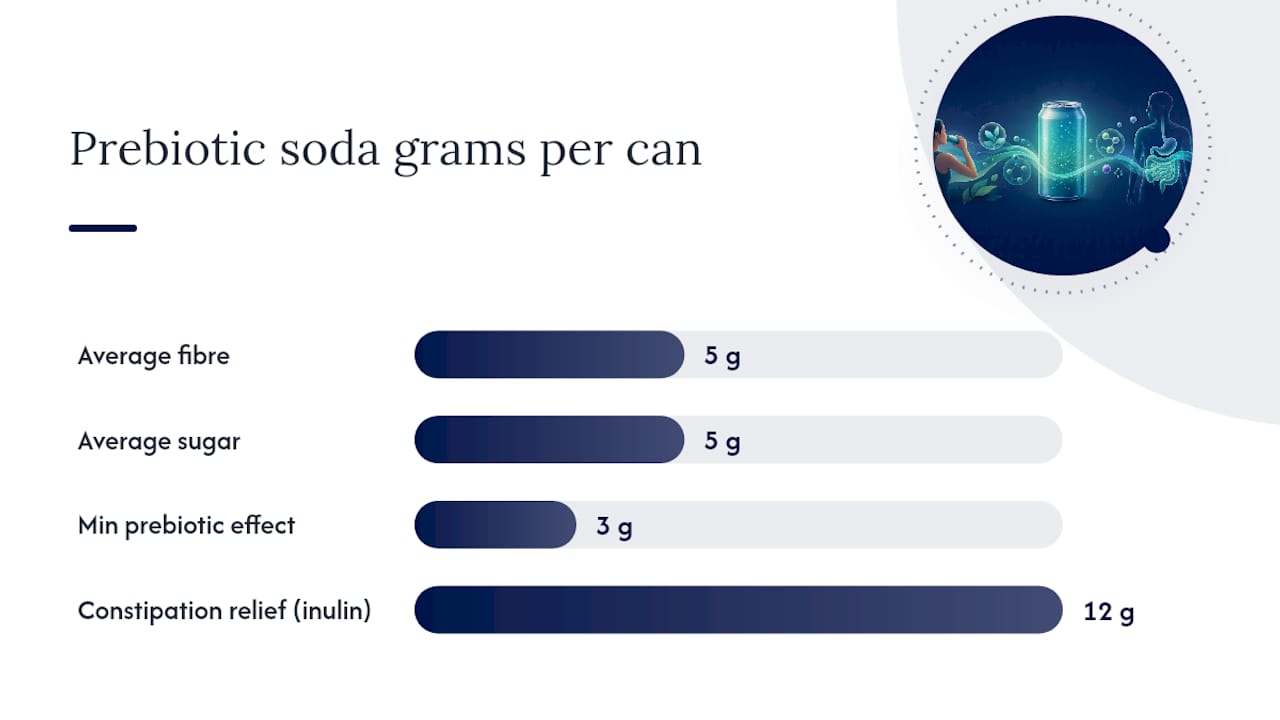
A University of Illinois review found products ranging from roughly 2 to 9 grams of fibre per can, and a market analysis of 108 US products presented at Nutrition 2026 put the average around 5 grams of fibre and 5 grams of sugar per 12 ounce can, close to what a soft drink loaded with cane sugar would run in calories, just with fibre instead of empty carbs. Researchers behind that analysis flagged something worth repeating: the health halo effect that comes with a “prebiotic” label can mask how modest the actual fibre dose is.
Some clinical work suggests you need at least 3 grams a day of prebiotic fibre before fermentation patterns shift meaningfully, while constipation relief in some studies required doses closer to 12 grams of inulin, well beyond what a single can provides.
Before you buy, run through this:
- Check grams of fibre per serving, not just the word “prebiotic” on the front.
- Find the actual fibre source in the ingredient list, inulin behaves differently than resistant dextrin.
- Look at total sugars and serving size together; some “low sugar” claims rely on tiny serving sizes.
What the evidence actually supports
The plausible benefits line up with what fibre does generally: better bowel regularity, short-chain fatty acid production, a bit of extra satiety, and possibly small metabolic effects tied to slower glucose absorption. None of that is controversial for fibre broadly.
Where the evidence gets shaky is at the product level. Bon Appétit’s reporting and multiple health-system explainers note that while prebiotic sodas cut sugar compared to classic soda, proof that the sodas themselves meaningfully shift your microbiome is limited. Most of the research backing prebiotic fibre comes from isolated fibre studies, not from twelve-ounce cans of flavoured seltzer.
- Regularity improvements are the most consistently reported effect.
- Satiety and metabolic benefits are modest and inconsistent across studies.
- Benefit shows up most reliably when the soda replaces a sugary drink, not when it’s added on top of an already fibre-poor diet.
The realistic takeaway: you’re probably not rebuilding your microbiome with one can a day, but you might be avoiding 30+ grams of added sugar you’d otherwise be drinking.
Side effects and who should be careful
Fermentable fibre doesn’t always sit quietly. Inulin in particular ferments fast, and that speed is exactly why it can trigger gas, bloating, and cramping in people who aren’t used to it, sometimes at doses as low as a few grams.
- Gas, bloating, and mild abdominal pain are the most reported complaints.
- People with IBS or FODMAP sensitivity often react more strongly to inulin and chicory root than to gentler fibres like resistant dextrin.
- Pregnant people or anyone immunocompromised should run new fibre habits by their doctor first, not because prebiotic soda is dangerous, but because gut symptoms are easier to manage before they start.
The marketing risk matters just as much as the digestive one. “Prebiotic” and “no added sugar” on a label are not FDA-reviewed health claims, they’re descriptive terms brands are allowed to use loosely under existing food labelling guidance. Read the Nutrition Facts panel, not the front of the can.
Pro Tip: If a can gives you noticeable bloating, switch fibre sources before giving up entirely. Resistant dextrin and acacia fibre tend to be gentler than inulin at the same gram count.

How to drink it without wrecking your stomach
Fibre tolerance builds gradually, so don’t start with a full can if you’re new to this category.
- Start with half a can and see how your gut responds over a day or two.
- Build toward roughly 3 to 5 grams of total prebiotic fibre a day from all sources combined, not just soda.
- Drink water alongside it. Fermentable fibre without enough fluid is a common cause of the bloated, sluggish feeling people blame on the fibre itself.
A digestive health clinician’s overview of fibre makes a point worth repeating here: fibre works best as part of a varied diet, not as an isolated add-on. Treat prebiotic soda as a sugar swap or a small boost, never your main fibre source.
Pro Tip: If you’re also taking a fibre supplement, count the soda’s fibre toward your daily total. Stacking multiple fermentable fibre sources without adjusting is the most common reason people get blindsided by bloating.
Prebiotic soda vs kombucha, kefir, and whole foods
Kombucha and kefir work through a different mechanism entirely: they deliver live microbes, not fibre, so they’re solving a different problem than a prebiotic soda is. Sparkling water, by contrast, offers zero fibre and zero live cultures but also zero calories, which makes it the simplest choice if your only goal is cutting sugar. Diet soda swaps sugar for artificial sweeteners, trading one set of tradeoffs for another.

Whole foods still win on nutrient diversity. A cup of lentils or a pear gives you fibre alongside vitamins, minerals, and polyphenols no can of soda replicates. Clinical guidance is consistent on this point: prebiotic soda is a reasonable lower-sugar convenience option, not a stand-in for produce and whole grains. Where it earns its place is as a direct replacement for the sugary can you were already going to drink, explored further in this comparison of carbonated drink alternatives.
Why Solidviibe takes a straight-talk approach to gut health claims
Solidviibe builds its sparkling tonics around natural ingredients, low sugar, and functional flavours like lemon-ginger and passionfruit, without leaning on vague “gut health” language to sell a can. That distinction matters given how loosely “prebiotic” gets used across the category.
- Formulations prioritize genuine flavour and lower sugar over inflated wellness claims.
- Sharon, this article’s author, focuses coverage on evidence-based beverage reporting rather than brand-driven hype.
- Related reading: what sugar in soda actually does to your body and cooler canned alternatives to regular soda.
What the research actually tells you to prioritize
The conventional wisdom on prebiotic soda splits into two camps that are both a little wrong. One camp treats it like a microbiome miracle. The other dismisses it as flavoured fibre water with nothing to offer. Neither holds up against the actual data.
What the evidence supports is narrower and more useful: swapping a sugary soda for a prebiotic one is a solid, low-effort move if you’re already drinking soda daily, but it’s not doing the heavy lifting your gut actually needs. That lifting happens with legumes, vegetables, and whole grains, the boring stuff dietitians have said for decades.
Where I think most coverage of this category goes wrong is treating fibre grams as interchangeable. Five grams of inulin and five grams of resistant dextrin do not feel the same in your gut, and nobody’s front label tells you that. If you take one thing from this, make it this: read the ingredient list before the marketing copy, and treat the fibre count as a starting point for your day, not the whole picture.
— Sharon
A lower-sugar sparkling option worth trying
If you’re already looking to cut back on sugary soda, Solidviibe gives you a straightforward next step: sparkling wellness tonics built with natural ingredients, low sugar, and no artificial additives, in flavours like lemon-ginger, passionfruit, and peach.

Unlike relying on fibre alone to fix a soda habit, Solidviibe’s cans are formulated for flavour first, so the swap doesn’t feel like a compromise. Each can is nutrient-enriched with vitamins and minerals supporting gut health and immunity, sold in single cans or variety packs for anyone who wants to try more than one flavour before committing. This isn’t a medical treatment or a fibre-dosing tool, it’s a genuinely better-tasting alternative to the soda you’re trying to move away from. Head to Solidviibe’s variety packs and pick a sampler to find your flavour.
Key Takeaways
Prebiotic soda cuts sugar reliably but offers only modest, unproven gut benefits at typical can-level fibre doses.
| Point | Details |
|---|---|
| Know the fibre range | Most cans carry 2 to 9 grams of fibre, with a market median near 5 grams per 12 ounce can. |
| Prebiotic isn’t probiotic | Soda feeds existing gut bacteria with fibre; it doesn’t add live cultures the way kefir or kombucha does. |
| Start slow | Begin with half a can and build toward 3 to 5 grams of daily fibre from all sources to avoid bloating. |
| Read past the label | “Prebiotic” and “no added sugar” are marketing terms, not FDA-reviewed health claims. |
| Choose flavour without the sugar spike | Solidviibe offers low-sugar, natural-ingredient sparkling tonics as a practical everyday soda swap. |
This article is general information, not a substitute for advice from a qualified doctor. Consult a qualified healthcare professional about your own circumstances before acting on anything here.
Sources
- Study warns prebiotic sodas’ “health halo” may mask limited fiber and gut benefits
- Are Prebiotic Sodas Good for You? — Cleveland Clinic
- Review on prebiotic fibres and gastrointestinal outcomes — PMC
- What Is Prebiotic Soda—and Is It Actually Good for You? — Bon Appétit
Recommended
- Carbonated drink alternatives comparison guide for 2026 – Drink Solidviibe
- The best fiber orange drink for gut health in Canada – Drink Solidviibe
- What are probiotic drinks for children? A parent’s low-sugar guide – Drink Solidviibe
- Coolest canned beverages as your soda replacement – Drink Solidviibe


